ISO 9001 Document Management System: What It Is and What to Check
A document management system keeps every document's current version, approvals and access history in one place. How it differs from a shared folder, what ISO 9001:2026 means for you and how to choose software.
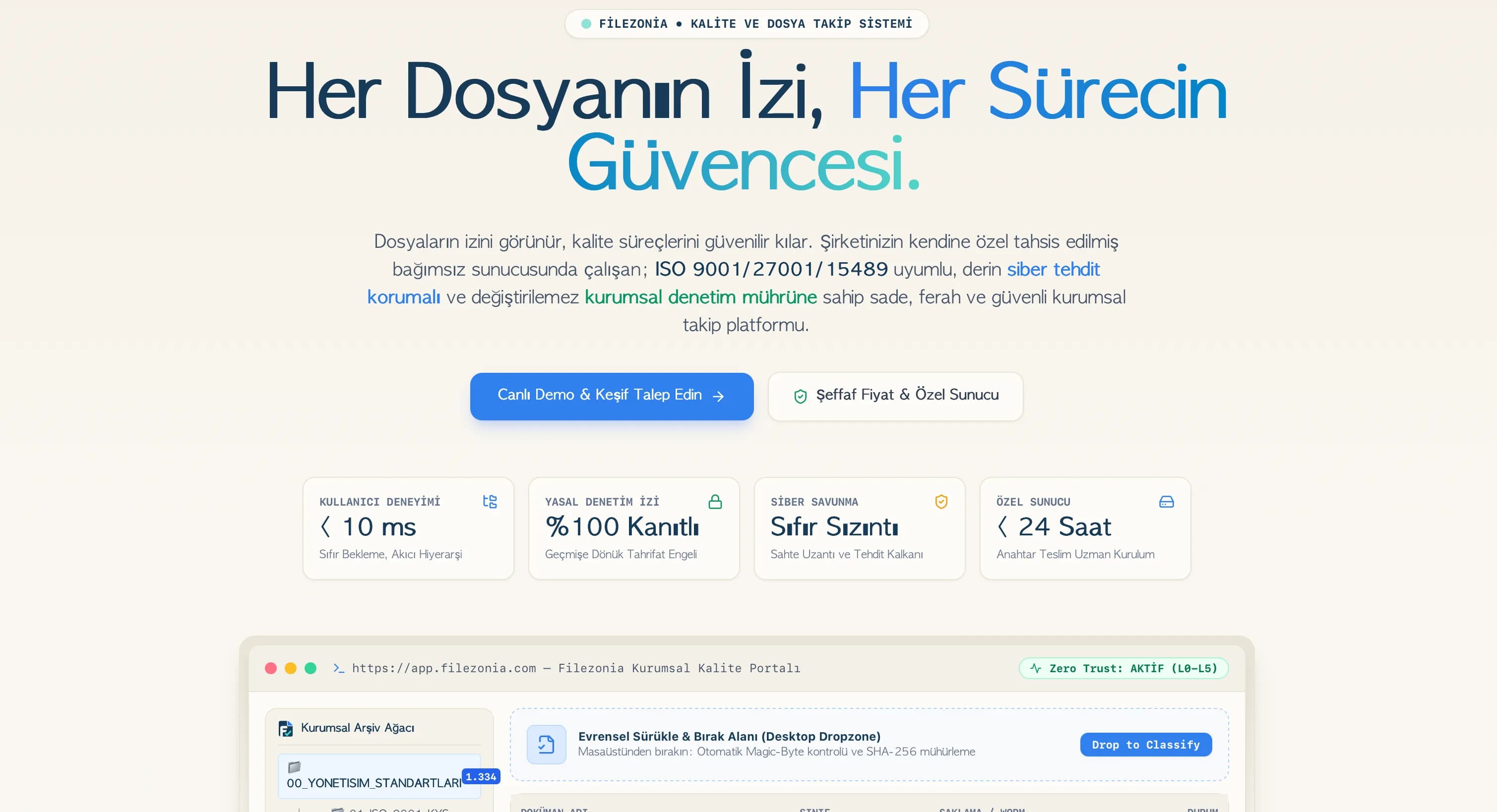
A document management system (DMS) is software that stores company documents in one structure and records the current version, the approval and the access history of every document. The difference from a shared folder is not storage but lifecycle control: who prepared a document, who approved it, which version is in force, when it moves to the archive and when it is destroyed. When quality teams search for "ISO document control software" or an "ISO filing system", this is the need they are describing.
What does a document management system actually do?
The daily job of a DMS is to make documents findable and trustworthy. It does this through six core functions:
- Version control: When a procedure is revised, the old version moves to the archive and employees only see the version in force.
- Approval workflow: The people who prepare, review and approve a document are defined, and nothing is published without approval.
- Permissions: Who can see, edit or only read each folder is set by role.
- Audit trail: Views, downloads, changes and deletions are logged with date and user.
- Retention and disposal: A retention period is defined per document type; expired documents are destroyed in a controlled way and a disposal record is kept.
- Classification and search: Documents are found by document code, department or type, so nobody has to ask which folder the latest file ended up in.
Why is a shared folder not enough?
A shared drive or cloud folder works for a small team for a while. The trouble starts when the number of documents and the need for audits grow.
The first problem is the missing trail. When a file in a folder is overwritten or deleted, it is often impossible to tell who did it. The auditor's question "who approved this revision?" goes unanswered.
The second is version chaos. File names like "Purchasing_procedure_final_v3_revised.docx" are a picture we see often. From a quality point of view, an operator working from an outdated instruction is a bigger risk than having no document at all.
The third is permissions and security. Sensitive files such as personnel records, contracts and quotes can sit in folders everyone can open. Ordinary folders also only look at a file's extension; they do not check what the file really contains.
What does ISO 9001 expect from document management?
ISO 9001 does not require any particular software. What it expects is that documented information is under control. In the 2015 edition this requirement sits in clause 7.5. In practice, an audit looks at questions like these:
- Are documents properly identified (title, date, author, document code)?
- Were they reviewed and approved before release?
- Are they available where and when they are needed?
- Are they protected against unauthorized change and loss?
- Have obsolete versions been withdrawn from use?
- Are documents of external origin (customer specifications, standards, regulations) under control?
- Are quality records kept for the defined period?
All of this can be managed with paper and spreadsheets. Once you have hundreds of documents, though, manual tracking eats time and turns every audit into weeks of tidying up beforehand.
What changed with ISO 9001:2026?
The new edition of the standard was published on 16 September 2026. According to the schedule shared by TÜV Rheinland, organizations have a three-year window, until September 2029, to transition from the 2015 edition. The new edition puts more emphasis on quality culture, ethical behavior and treating risks and opportunities separately, while the core requirements are largely kept.
The practical consequence for document management: you do not need to rebuild your system, but your quality manual, procedures and forms will be revised against the new edition over the coming period. That is exactly when version control and approval workflows are under the most pressure. We recommend agreeing your transition timeline with your certification body.
Where do ISO 27001, records management and data protection come in?
Beyond quality, two more standards bear directly on document management. ISO/IEC 27001 covers information security management, and it also expects access control and activity logs. ISO 15489 focuses on records management: how long each record is kept and how it is protected from alteration.
If your documents contain personal data (personnel files, customer contracts, copies of ID cards), data protection law applies. For companies operating in Turkey this is Law No. 6698 on the Protection of Personal Data (KVKK). It requires the data controller to take technical and administrative measures for an appropriate level of security, and it governs the erasure, destruction or anonymization of personal data once the purpose of processing no longer exists. That is why a good DMS should let you tie retention periods and disposal rules to document types.
What should you check when choosing document management software?
- Versioning and approval flow: Can you build the approval steps around your own organization?
- Reliability of the audit trail: Can logs be altered afterwards? If they are, does the system notice?
- Role-based permissions: Can access be granted at department, project and document type level?
- Retention and disposal rules: Can you set periods per document type and produce a disposal record?
- Hosting model: Will your data sit in a shared multi-tenant cloud, on a server dedicated to you, or in your own data center?
- Licensing model: Is it a monthly per-user fee or a fixed fee? How does the cost change as the team grows?
- Migration and training: Who is responsible for moving existing documents and training staff?
How does an implementation usually run?
A healthy DMS project starts with a document inventory, not with software. First you map which document types exist and who prepares and approves each one. Then you set a document coding scheme (for example PR-PUR-001: procedure, department, sequence number). A role and permission matrix is prepared, and old documents are cleaned up before they are migrated.
The most common mistake we see is moving old folders into the new system as they are. Once duplicates and obsolete versions get in, the team stops trusting the system from day one. Starting with a pilot in one department and then expanding is far less painful.
Filezonia: Piküp's document control system
Filezonia is the corporate quality and document control system we develop at Piküp Medya. It was designed to meet the selection criteria above: it reads the first bytes of each uploaded file and compares the real file type with the extension, it keeps an audit chain that cryptographically links every document action to the previous record, and it offers an archive layer in which documents cannot be deleted before their legal retention period ends. At setup you choose your sector, and the ISO folder tree and document code template are prepared accordingly.
Filezonia runs on an isolated server dedicated to each company or on the company's own server, and there is no per-user pricing. We also cover hosting and security on our server and infrastructure services page. If you would like to talk through which model fits your own document structure, get in touch.
In short: before you decide
- Write down your document inventory and approval flow.
- Agree your ISO 9001:2026 transition timeline with your certification body.
- Identify which document types contain personal data and set their retention periods.
- Evaluate software against this list; do not bend the list to fit the software.
Related service
Filezonia document managementSee how we work →How did this land for you?
Be the first to react
Found it useful? Share it:
Frequently asked questions
Is a document management system the same as an electronic records system?
The concepts are close, but the focus differs. In Turkey the term EBYS is mostly used for the electronic handling of official correspondence and paper flow. A document management system focuses on version, approval and retention rules for internal documents such as procedures, work instructions, forms and records.
How long is our ISO 9001:2015 certificate still valid?
ISO 9001:2026 was published on 16 September 2026, and according to the schedule shared by TÜV Rheinland there is a three-year transition period until September 2029. You should plan your audit schedule and the timing of your transition audit together with your certification body.
Should a document management system be in the cloud or on premises?
Both are possible; the decision depends on your document types and your risk appetite. A shared cloud gets you started quickly, while a dedicated server or an on-premises installation gives you more control over where data lives and who can reach it. For documents containing sensitive personal data or trade secrets, that control usually becomes the priority.
Do we need to bring our paper archive into the system as well?
Not all of it. Start by scanning and classifying the procedures, instructions and forms in force, plus records whose retention period is still running. Documents whose retention period has expired need a separate disposal decision; digitizing them only adds to the load.
Sources
- What you should know about the ISO 9001:2026 revision — DQS
- Overview & schedule: Revision of ISO 9001 coming in 2026 — TÜV Rheinland
- ISO 9001 revision update — ISO/TC 176/SC 2, 2026-08-07
- 6698 sayılı Kişisel Verilerin Korunması Kanunu — T.C. Cumhurbaşkanlığı Mevzuat Bilgi Sistemi
Related articles
- Web & Software
ISO 9001 Document Control: Revisions, Distribution, Approval
ISO 9001 document control comes down to three things: who approves, who receives the current version, and how old copies disappear. Here is a practical setup.
5 min read - Web & Software
Corporate Digital Business Card Management for Teams
How to manage corporate digital business cards across teams: who owns what, which roles to set up, and how to keep templates consistent.
4 min read - Web & Software
Dealer & Channel Management Software: Run Your Network End to End
Learn how dealer & channel management software brings orders, pricing, stock and dealer performance into one place, and how to choose the right setup.
4 min read