ChatGPT Ads in Türkiye: How Your Brand Can Show Up in ChatGPT
Businesses based in Türkiye can now advertise in ChatGPT. Who sees the ads, how targeting works, what advertisers can measure and how to stay visible without ads, based on current OpenAI documentation.
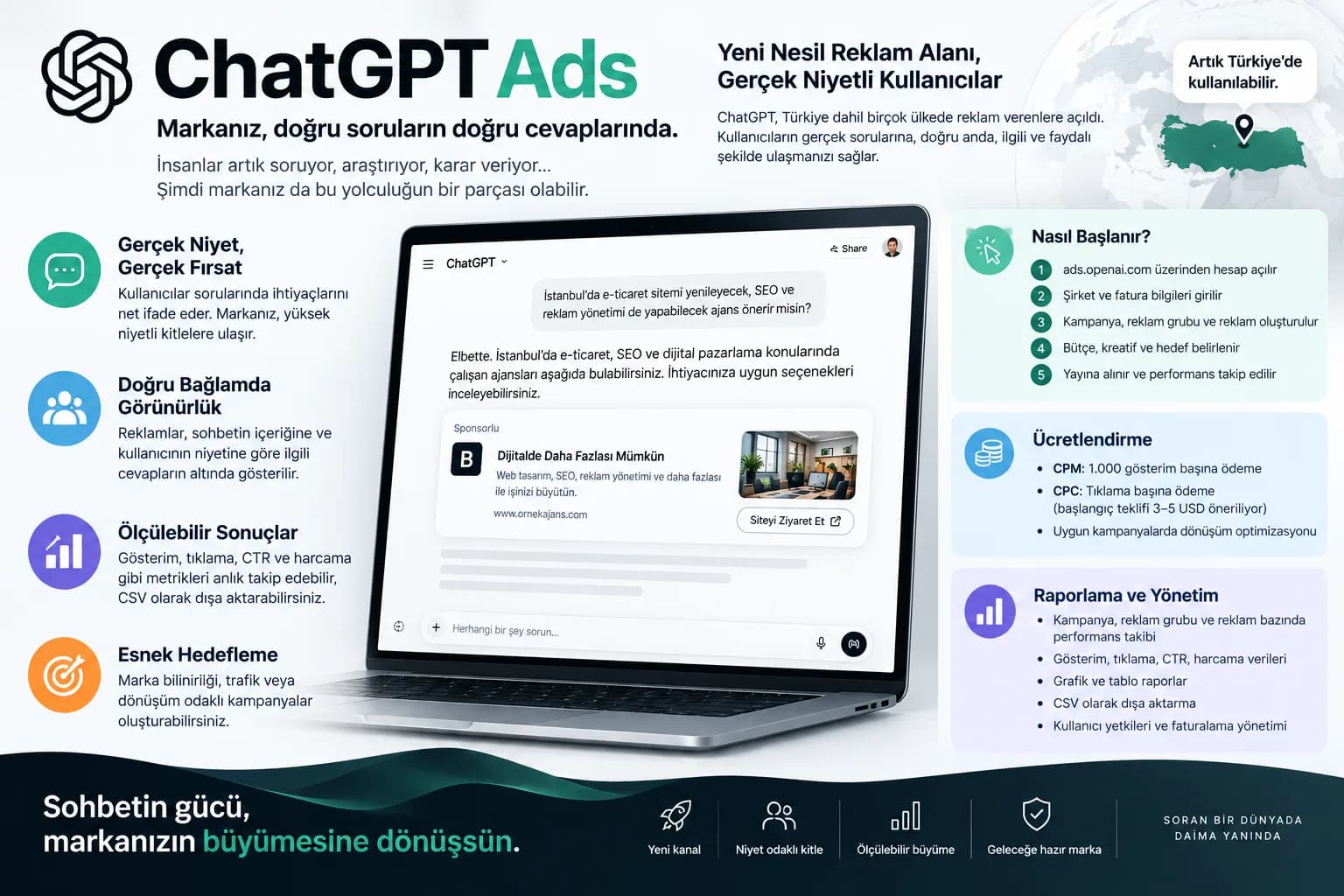
There are two separate ways for your brand to appear in ChatGPT. The first is paid advertising: in mid-September 2026, Türkiye was added to the list of countries eligible for OpenAI's Ads Manager, so businesses established in Türkiye can now open their own ad accounts. The second is organic visibility: being cited as a source or recommended by name in ChatGPT's answers. OpenAI says ads do not influence answers, which means the second route cannot be bought and needs its own work.
What exactly changed in Türkiye?
OpenAI began testing ads in ChatGPT in the United States on February 9, 2026. Pilots were then announced in Canada, Australia and New Zealand, and as of August 11, 2026 ads went live in the United Kingdom, Mexico, Brazil, Japan and South Korea. In the Ads Manager availability table in the OpenAI Help Center, Türkiye is listed as "Available" as of late September 2026.
That table describes the advertiser side: to use the self-serve Ads Manager, the legal entity placing and paying for the ads must be established in a listed country. Press reports also show that users in Türkiye have started to see ads. If ad controls appear under Settings in your own account, your region is covered; OpenAI shows these controls only in regions where ads are served or will be served soon.
Who sees ChatGPT ads, and where do they appear?
According to OpenAI's help page, ads are shown only to users on the Free and Go plans. Plus, Pro, Business, Enterprise and Edu accounts have no ads. Ads are not shown to accounts identified as belonging to users under 18, or in temporary chats.
The ad appears below the end of the answer, labeled "sponsored" and visually separated from the answer. Ads are not shown next to sensitive or regulated topics such as personal health, mental health and politics, and political ads are not allowed at present. Advertisers in regulated sectors such as health and finance can advertise only if they meet strict eligibility criteria.
That last point matters for clinics and financial companies. OpenAI's rules apply on top of your own national sector regulations, not instead of them. Check both the platform policy and the local rules before building a campaign in these sectors.
How does ChatGPT decide which ad to show?
Early announcements stressed that ads would be matched only to the current conversation. That description is now incomplete. According to OpenAI's current documentation, the system looks at:
- The context and intent of the user's current conversation.
- The ad's headline, copy, landing page, any context hints the advertiser provides, and targeting choices.
- General location and language.
- If the user keeps ad personalization on, past chats, memory and their history of interacting with ads.
When several eligible ads compete, ranking weighs relevance together with the advertiser's bid. If a user turns personalization off, ads are chosen based on the current conversation only. Advertisers do not see conversations, memory or personal information; they receive only aggregate performance data such as impressions and clicks.
The practical consequence: the system reads your landing page too. OpenAI's crawler OAI-AdsBot checks pages submitted as ads for safety. If your firewall or CDN settings block this crawler, your campaign can run into problems before it starts.
How are ChatGPT ads different from Google Ads?
On Google, a user types a query of a few words and the ad is matched to that keyword. In ChatGPT, users describe their problem in sentences and often add their budget, location and constraints. The ad is shown at the end of that context, to someone who has just read the answer. So your ad copy should answer the next step of the question rather than repeat a keyword.
The second difference is measurement. Because advertisers receive only aggregate impressions and clicks, do not expect a report on what was said in the conversation. The way to learn which questions bring customers is to track landing page behavior and conversions carefully in your own analytics tool. The third difference is maturity: the channel is new, so there are no years of benchmark data as there are for Google Ads. You will learn from your own tests.
Users can ask ChatGPT directly about a product in an ad, and in some formats they can send a message to the advertiser. In that case the advertiser sees only the messages sent to them. Planning a team or a flow that answers questions from inside the chat quickly and clearly is what separates this channel from a classic click ad.
How can you appear in ChatGPT without ads?
The first requirement is technical. OpenAI recommends allowing OAI-SearchBot in your robots.txt file to appear in ChatGPT search results, and says sites that block this crawler will not be shown in search answers. GPTBot, which is used for model training, is a separate crawler; blocking one does not block the other.
The second requirement is content and reputation:
- Your service pages should answer the customer's question directly in the first paragraph.
- The one sentence that describes what you do should be the same on your website, your Google Business Profile and industry directories.
- Mentions of your name outside your own site, in industry publications and partner listings, can affect your chances of being recommended more than any new page on your site.
The two routes do not replace each other. Ads give you visibility while the campaign runs; organic work is an asset that stays when you stop spending.
Who is this channel worth testing for now?
Businesses whose customers compare options before buying: e-commerce brands, software and SaaS companies, education providers, tourism and hospitality businesses, and B2B service firms. Questions like "which accounting software suits a small business?" or "a family-friendly hotel in Cappadocia" are this channel's natural territory.
Some sectors need more caution. Political content is out of scope anyway. In health, finance and law, the limits set by both the platform and local regulation are narrow; in Türkiye, for example, online advertising by lawyers is already prohibited under professional rules.
Because the channel is new, there is no reliable benchmark yet for conversion costs in Türkiye. Start with a small test budget and compare the results against your existing channels using the same metrics.
Five steps before you start
- Confirm eligibility. Check that the company placing the ads is established in an eligible country and that you can open an account at ads.openai.com.
- Fix crawler access. Make sure OAI-SearchBot and OAI-AdsBot are not blocked in robots.txt, your CDN or your security plugin.
- Build a single-purpose landing page. Someone arriving from a conversation should see the answer to their question and one clear next step. A slow page, or one that breaks on mobile, wastes budget.
- Set up measurement. Add UTM parameters to ad links and track conversions separately in your analytics tool.
- Record your organic baseline. Ask ChatGPT the 15 to 20 questions your customers ask and note whether your brand appears. Read the effect of your ads against this baseline.
If you want support on the landing page side, see our conversion optimization service. For organic visibility, see our AI search optimization page.
Related service
Google Ads managementSee how we work →How did this land for you?
Be the first to react
Found it useful? Share it:
Frequently asked questions
Do ChatGPT ads change the content of the answers?
OpenAI says no. Ads run on systems separate from the chat model, and advertisers have no way to shape, rank or alter answers. An ad being shown also does not mean OpenAI recommends that brand.
Can users turn off ads in ChatGPT?
Users can move to the Plus or Pro plan for an ad-free experience. Free plan users can also choose an ad-free option in exchange for lower message limits and restricted tool access. Ad personalization can be switched off and ad data can be deleted.
What data do I see as an advertiser?
According to OpenAI, advertisers receive only aggregate, non-identifying performance data such as impressions and clicks. Users' chats, memory, name, email address or precise location are not shared. If a user messages you directly through an ad, you see only those messages.
Can an agency in Türkiye open an ad account for a client in another country?
The self-serve rule requires the legal entity placing and paying for the ads to be established in an eligible country. So what counts is the advertiser's country, not the agency's. For more complex needs, OpenAI also describes a route through its ads team and partners.
Sources
- Ads Manager Availability — OpenAI Help Center
- Ads in ChatGPT — OpenAI Help Center
- Testing ads in ChatGPT — OpenAI
- Overview of OpenAI Crawlers — OpenAI
- Türkiye Barolar Birliği Reklam Yasağı Yönetmeliği — T.C. Cumhurbaşkanlığı Mevzuat Bilgi Sistemi
Related articles
- Digital Marketing
Display Ads for Brand Awareness: A Practical Approach
Display ads rarely get clicks the way search does. Here's how to use them properly for brand awareness without wasting budget on vanity impressions.
3 min read - Digital Marketing
Social Media Trends 2026: What They Mean for Your Brand
In 2026, reach on social media depends on interest matching rather than follower count, AI is in everyone's hands and measurement matters more than ever. Priorities for brands, based on current reports and Turkey data.
6 min read - Digital Marketing
How to Choose a Google Ads Agency: 7 Questions on Accounts and Fees
Who should own the Google Ads account, when should conversion tracking be set up, and how should the agency fee be put in writing? Seven questions for choosing a Google Ads agency, based on Google's own Third-party policy.
7 min read